
A Guide to Trade Promotions Effectiveness Analysis
Trade promotion effectiveness is hard to pin down for a frustrating reason: trade promotions are the single largest discretionary spend on most CPG P&Ls, often 15 to 25 percent of gross sales, and the analysis behind them is still dominated by post-event recaps that land too late to change the next plan. Most teams measure one number, lift, and stop there. That misses where promotions actually win or lose.
This guide walks through the five-signal framework we use with brands at Scout to evaluate trade promotion effectiveness. There's a worked example, the failure modes that most often distort the numbers, a decision rule for repeat-versus-kill, and the calculations behind each signal. If you're trying to size a future event, start with How to Forecast Trade Spend ROI for Promotions. If you're brand-new to the discipline, What Is Trade Promotions Analysis? is the prerequisite primer.
Across the analyses we've run with mid-market CPG brands from 2023 to 2025, roughly one in three promotions shows what we call a velocity-only success: visible in-store lift, but negative or near-zero incremental profit once you net out trade spend, cannibalization, and the post-promo dip. The framework below exists to catch that pattern before the next plan locks.
The five-signal trade promotion effectiveness framework
A healthy promotion shows balanced strength across five dimensions. Each one maps to a question a sales, finance, or category lead is going to ask anyway:
- Velocity is the immediate response. Did units lift relative to baseline?
- Profit is the commercial test. Did the lift cover its own trade cost?
- Mix shows where the lift came from. Incremental category demand, or share stolen from the rest of the line?
- Retailer shows strategic alignment. Was the gain concentrated at the partners that matter, or scattered across accounts that don't?
- Sustain-lift tells you whether the gains stuck or unwound. Did the brand grow, or did you just borrow from the future?
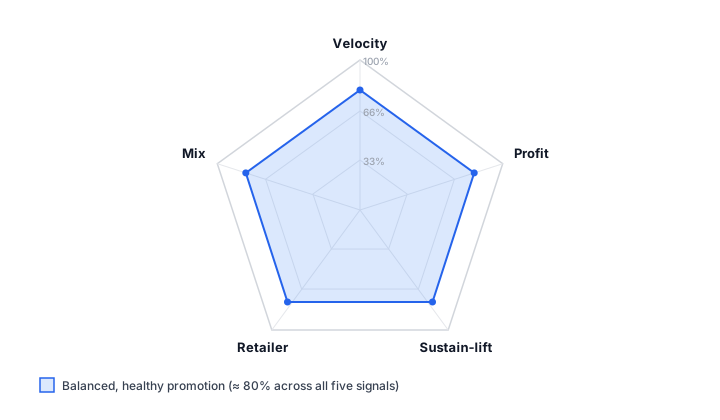
A healthy promotion shows balanced strength across all five. When one signal spikes while another collapses (strong velocity but negative profit, say) the strategy needs work. Two signals red is rarely fixable with depth tweaks. It usually means changing the mechanic or killing the event outright.
Track these five consistently over time and post-event recaps stop being autopsies. They turn into a feedback system that teaches the organization what actually drives effective trade spend.
The calculations
Here are the calculations we use:
| Metric | Formula | Interpretation |
|---|---|---|
| Incremental Units | Promo Units − Baseline Units | Core lift measurement. |
| Incremental Revenue | Incremental Units × Promo Price | Sales generated by the promotion. |
| Incremental Profit | Incremental Revenue − Incremental Cost − Trade Spend | True financial gain. |
| Trade ROI | Incremental Profit / Trade Spend | Return on trade investment. |
| Elasticity | % change in volume / % change in price | Shopper sensitivity indicator. |
| Sustain-Lift Ratio | Post-promo baseline / Pre-promo baseline | Longevity of effect. |
A worked example: the sustain-lift ratio
The sustain-lift ratio (SLR) is the single most diagnostic post-event signal, and the one most likely to flip a conclusion. It compares average baseline sales in the 8 weeks right after a promotion to the 8 weeks right before it.
Take a mid-tier natural snack brand running a 4-week TPR at one West Coast retailer:
- Pre-promo baseline (W-8 to W-1): 14,200 units per week
- Promo window (W1 to W4): 23,500 units per week, a 65% lift on the headline
- Post-promo baseline (W5 to W12): 13,100 units per week
The lift is real: about 9,300 incremental units a week during the promo, or roughly 37,200 across the 4-week window. But the post-promo baseline drops to 13,100, an SLR of 0.92, which costs about 8,800 units across the 8 weeks of dip. Net it out and you have 28,400 incremental units, around 76 percent of what the headline lift suggested.
If trade spend was sized against that headline number, the promotion likely lost money. This is the discipline a five-signal analysis enforces. Velocity alone said 'huge win.' The sustain-lift ratio said 'you borrowed from the future, and the future paid back less than expected.' Same data, opposite conclusion.
Common failure modes
Most breakdowns in trade promotion analysis come down to data, timing, or behavior.
Data
Different systems capture different truths. Syndicated data, retailer portals, and internal shipments rarely line up on timing or hierarchy. When the baseline calculation is inconsistent, lift and ROI are inconsistent too.
Teams cope by 'adjusting' results by hand, which is exactly what erodes trust in the analysis.
The fix is standardization. Have one source of truth for baseline definitions, calendar weeks, and spend attribution. And remember that banner-level pricing decisions live at the banner, not the corporate parent. Andronicos and Safeway both roll up to Albertsons but make different trade calls. Aggregate them and you've hidden the answer.
Timing
By the time a recap is finished, the next promotional plan is already locked. The team learns what happened and can't do anything with it.
Promotional data has a short shelf life. Its value decays week by week. Shortening the analysis cycle through automation or templated reporting lets insight reach future planning instead of just explaining the past. A useful target: the recap of a promotion should make the next planning meeting, not the one after that.
Behavior
Build the team's habits around the analysis and you get an edge. The patterns that get in the way are familiar:
- Anchoring bias: assuming last year's tactics will work again.
- Volume bias: equating lift with success, profit and mix be damned.
- Siloed interpretation: sales, finance, and category each draw their own conclusion from the same numbers.
Get teams aligned on a shared reading of the key metrics and a standard set of dashboards, and the emphasis shifts from assigning blame for outcomes to improving the next set of choices.
From calculations we've done for brands, lift does not always translate into ROI. A promotion can create a short-term spike and quietly erode baseline loyalty at the same time. Category-aligned, moderate-depth promotions tend to outperform when you look out over an 8-week horizon. For a closer look at how to confirm that lift wasn't just pulled forward, see How to Tell If a CPG Promotion Actually Worked.
When to repeat, change depth, or kill
Once a promotion has been run through the five signals, three decisions follow. The table sums up the conditions for each:
| Decision | Velocity | Profit | Sustain-lift | Mix / Retailer |
|---|---|---|---|---|
| Repeat as-is | ≥ 1.5× baseline | Positive after dip | ≥ 0.95 | Balanced across SKUs and retailers |
| Reduce depth (10–15%) | ≥ 1.5× baseline | Marginal | 0.85–0.95 | Imbalanced, concentrated in a few SKUs |
| Change mechanic | 1.2–1.5× baseline | Negative | ≥ 0.95 | Wrong vehicle for category |
| Kill | < 1.2× or negative | Negative | < 0.85 | Concentrated, cannibalistic |
A rule of thumb that holds up: if two of the five signals are red, you're either changing the mechanic or killing the promotion. And two greens in isolation aren't a green light. They're an invitation to look harder at the other three.
New steps to promotional planning
- Forecast likely ROI and lift ranges before approval. See How to Forecast Trade Spend ROI for Promotions.
- Watch mid-event velocity deltas so you can intervene before the promo window closes, not after.
- Pull structured lessons into a searchable playbook: one row per event, indexed by retailer, mechanic, and depth.
- Measure consistency across the five-signal radar rather than chasing one metric and ignoring the rest.
That turns trade analysis from a backward-looking report into an adaptive model that compounds insight. The shift in operating model, from cost ledger to capital allocation, is covered in From Cost Center to Profit Driver: Rethinking the Role of Trade Spend.
The next frontier is AI-driven trade spend optimization, and the direction looks like autonomous learning loops. An AI system runs the elasticity simulations, sales picks 2 or 3 to test, finance validates the ROI after the event, and the learnings feed straight into next cycle's spend recommendations. We're already seeing mid-market leaders move that way, and it's a matter of quarters, not years.
What this framework will not catch
Two things the five-signal framework is genuinely bad at, and we'd rather say so. First, brand-equity effects below the 12-week horizon. If a deep discount erodes shelf-price expectations and shows up as elasticity drift six months later, no single-event recap will catch it. That signal lives in trend lines, not event recaps, and the only real defense is a baseline price discipline enforced upstream of the promo itself.
Second, competitor-driven category effects. If a competitor runs a counter-promotion that compresses category demand during your post-promo window, your sustain-lift ratio reads worse than it should. Mitigate it by always pulling category-level sales over the same window: if your brand dipped and the category dipped with it, your dip is partly category, not all yours. We treat that adjustment as advisory, not mechanical. Better to flag it than auto-correct, because the wrong adjustment is worse than no adjustment.
Frequently asked questions
- What's the difference between lift, incrementality, and ROI?
- Lift is the gross change in units or dollars during the promo window. Incrementality is the portion of that lift that wouldn't have happened without the promo (lift minus what baseline plus cannibalization would have produced). ROI is incremental profit divided by trade spend; it answers whether the incremental part paid for itself.
- What's a good sustain-lift ratio?
- Above 1.00 is genuine brand growth: the promo expanded baseline demand. 0.95 to 1.00 is acceptable. 0.85 to 0.95 means meaningful pull-forward; the promo was net-incremental but smaller than the headline. Below 0.85 indicates significant borrowed demand, and the promo likely lost money once netted.
- How long after a promotion ends should I wait to evaluate it?
- An 8-week post-window is the standard. 4 weeks usually misses the back half of the dip; 12 weeks or more introduces too much noise from competitor activity and category seasonality. If the category is highly seasonal (allergy, ice cream, and the like), match the window to the prior-year same period rather than calendar weeks.
- How do I separate the post-promo dip from competitor activity?
- Look at category-level sales over the same window. If category sales held steady while your brand dipped, the dip is real (loyalists pulled forward). If category sales also dipped, you're seeing a category effect (competitor promotion, seasonality, or macro factors) and your dip is overstated.
- What's the most common reason a 5-signal analysis disagrees with a sales recap?
- The sustain-lift ratio. A sales recap stops at the end of the promo window; a 5-signal analysis carries the read into the 8 weeks after. Roughly a third of promotions that look like clear wins on the recap turn out margin-negative once the post-promo dip is netted in.
- Should I run the analysis at SKU level or brand level?
- Both. SKU-level catches cannibalization within the line: the promoted item gaining at the expense of its siblings. Brand-level confirms the line as a whole grew, not just the promoted SKU. If SKU-level shows lift but brand-level doesn't, you have an internal-cannibalization problem, not a category-growth one.
Every dollar should teach you something. Reach out at hello@cpgscout.ai if you want to see how leading CPG brands have been putting this playbook to work.
See this on your own data
Scout gives CPG sales teams the analytics infrastructure they need — without spreadsheets.
Get a 15-min demo